Your AI Agent Doesn't Need One LLM. It needs the right model for the job and most enterprise AI stacks aren't built to make that call.
Somewhere in your AI budget right now, a frontier model is answering a question a five-cent model could have handled just as well.
You won't see it on a dashboard. It won't show up as a line item labeled "waste." It just quietly shows up, every month, as an AI bill that keeps climbing faster than usage seems to justify.
Here's the uncomfortable diagnosis: your model probably isn't too expensive. You're using too much intelligence for work that doesn't need it.
The one-model architecture made sense for about a year
When enterprise AI first moved into production, the architecture was refreshingly simple: Pick a model. Integrate the API. Ship it.

The single-model architecture: every request, regardless of task, flows through one LLM.
For a straightforward chatbot, that pattern can still hold up. But enterprise AI isn't just chat anymore. A single AI workflow might search internal knowledge, summarize documents, classify tickets, call internal systems, generate code, analyze data, and take multi-step action all inside one session.
Which surfaces a question most teams haven't had to ask yet: an AI agent doesn't have one job. It has many. So why is it running all of them through the same model?
A classification problem isn't a reasoning problem
Line the tasks up and the mismatch is obvious.
| Enterprise workload | What actually matters |
|---|---|
| Classify a support ticket | Speed and cost |
| Extract fields from an invoice | Throughput and consistency |
| Summarize a report | Language quality and context |
| Answer an internal question | Retrieval + generation |
| Generate production code | Reasoning + coding ability |
| Review a complex contract | Deep reasoning + long context |
| Solve a multi-step problem | Frontier-level capability |
A model tuned for hard reasoning is overkill for sorting a ticket into a queue. A small, fast model that's great at that same ticket is the wrong tool for reviewing a legal agreement. Yet most teams start and stay with:
Everything → the same model
It's the equivalent of routing every password reset to your most senior engineer. It works. Nobody would design it on purpose.
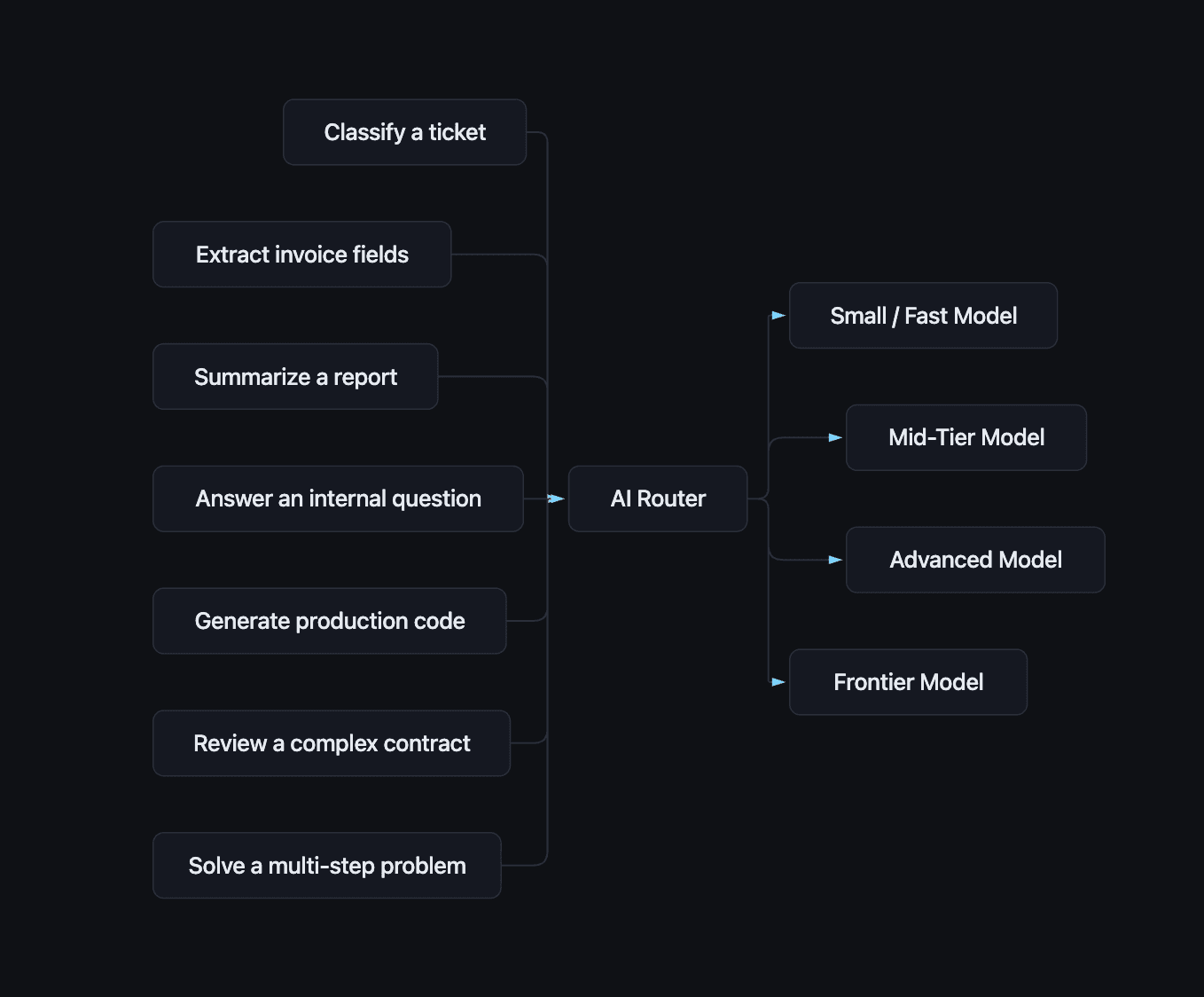
Different tasks need different model tiers from fast, cheap models for simple classification to frontier models reserved for genuinely hard reasoning.
What the industry actually looks like right now
This isn't a hypothetical concern it shows up directly in production traffic. Vercel's AI Gateway, which routes tens of trillions of tokens a month across real customer applications, found that open-weight models climbed from 11% of gateway token volume in April 2026 to 62% by late August. That's not a philosophical shift toward “cheaper AI” it's teams routing routine, high-volume work to lighter models while reserving frontier models for the calls where being wrong is expensive.
The spend data makes that split explicit: even at 62% of token volume, open-weight models captured under 9% of total spend, with closed frontier models still holding roughly two-thirds of the dollars. Volume and spend are pointing in opposite directions on purpose. That gap is the routing strategy most enterprises just haven't formalized it yet.
Independent analysis backs up why this matters financially: intentional multi-model routing on mixed workloads has been shown to cut token spend by 40–70% while improving reliability through cross-provider failover, largely because a large share of everyday requests never needed a frontier model in the first place.
The real problem isn't "expensive models" it's expensive models doing cheap work
The instinctive fix for a rising AI bill is "switch to a cheaper model." That's only half the fix. Say Model A costs $0.10 per call and Model B costs $0.30. Model A looks like the obvious win until it gets the task wrong. Then the system retries. Then it escalates. Then a second model checks the output. Then a human reviews it. You optimized the price of the first call and may have increased the total cost of finishing the job.
The right question was never:
"What's the cheapest model?"
It's:
"What's the least expensive model that can reliably complete this task?"
Then agents multiplied the problem
Ask an agent to "fix this authentication bug and open a pull request," and to the user that's one request. To the agent, it's a chain: understand the request → inspect the repo → find the relevant files → reason about the bug → write the fix → run tests → interpret failures → revise → review → open the PR.
Those steps are not equally hard. Classifying intent is trivial. Locating files barely needs reasoning. Writing the fix wants a strong coding model. Diagnosing a stubborn test failure might need something genuinely frontier-grade. Formatting the final output needs almost no intelligence at all.

Fixing one bug isn't one task it's a ten-step chain, and each step needs a different level of intelligence. (Green = small/fast model, yellow = mid-tier, red = frontier model.)
Green = small/fast model · yellow = mid-tier model · red = frontier model, called only when the failure actually needs it.
A one-model architecture quietly assumes every step deserves the same brain the same red box, ten times over. That assumption is where both the cost and the latency accumulate.
A more sensible shape looks less like a single call and more like a set of decisions made in sequence:

A routed agent pipeline: intent classification, planning, tool selection, reasoning, and validation each go to the model tier suited for that step not all to the same one.
The powerful model is still in the building. It's just not sitting in every meeting.
The big players are already building for this
This isn't a fringe idea anymore. AI gateways are quickly becoming a practical part of the production AI stack. Platforms such as OpenRouter already put a routing layer between applications and multiple model providers, handling provider selection, routing, and failover through a unified interface. Open-source gateways such as LiteLLM are taking a similar approach, giving teams a single API while adding routing, load balancing, spend controls, and observability. And the pattern is spreading beyond any single product.
Across the ecosystem, the architecture is converging on the same basic idea:
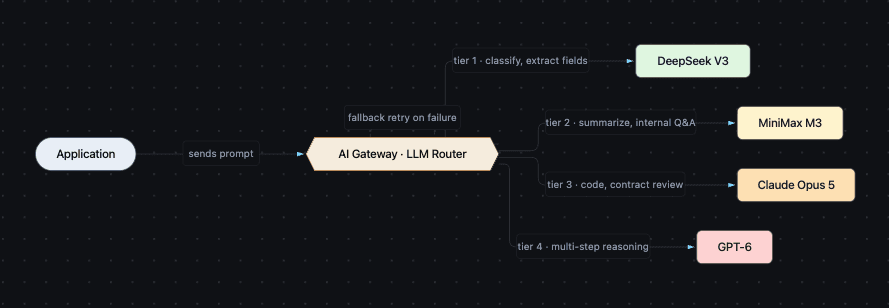
The AI gateway sits between applications and model providers, making the routing decision on cost, latency, capability, and availability that used to be hardcoded into every app.
The gateway becomes the decision layer in the middle deciding where a request should go based on factors such as cost, latency, capability, availability, and workload requirements.
That is an important shift.
The question is no longer just:
“Which LLM should we use?”
It is becoming:
“Which model should handle this request, through which provider, under which conditions?”
Once enterprises start asking that question, model routing stops looking like an optimization trick.
It starts looking like infrastructure.
What actually decides where a request goes
Good routing goes well beyond "easy request → small model." A production routing layer weighs several signals at once:
- Complexity how difficult is this request, really?
- Capability does it need reasoning, coding, vision, long context, or tool use?
- Cost how much should this task be allowed to spend?
- Latency does the user need this instantly, or can it wait?
- Reliability how consistently does this model complete this kind of task?
- Availability is the provider healthy and serving traffic right now?
- Policy are there security, geography, or data-residency rules in play?
The router isn't just picking a model. It's deciding how the task should be executed.
And then there's the provider problem
Even after you've picked the right model, you're not necessarily done the same model is often served by more than one provider, and providers differ on price, latency, throughput, and availability. So the real question isn't just which model? It's:
Which model, through which provider, for this workload, right now?
That question has gotten sharper this year for a reason worth naming directly: model availability itself is no longer guaranteed. In mid-2026, a US export-control action briefly pulled a leading frontier coding model from every customer worldwide including paying enterprise accounts with essentially no notice, before access was restored weeks later. Popular open-weight releases have hit their own version of this: when one widely-used open model spiked in popularity, its provider had to pause new subscriptions and split capacity between chat and coding traffic because throughput collapsed. Capacity, it turns out, is just as volatile as pricing.
An application hardcoded to one model, from one provider, doesn't have a good answer to either scenario. A routing layer does it just moves the traffic.
The hidden cost: every team reinventing routing on its own
Now imagine every application in the company solving this independently. Customer support has one set of rules. The coding agent has another. HR has a third. Finance has a fourth.
Six months later, one team is still on a deprecated model, another has a provider hardcoded into a script nobody wants to touch, a third built its own failover logic, and nobody remembers why two nearly identical workflows are routed completely differently. Somewhere in the architecture diagram sits a box labeled "temporary routing logic." It's been there for over a year.
This is the point where routing stops being an application concern. It becomes infrastructure.
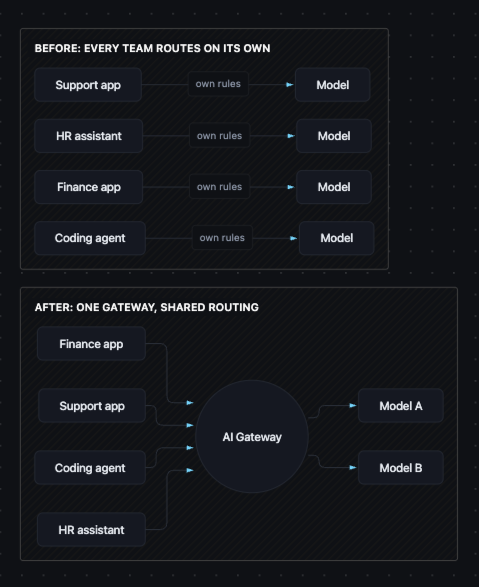
Before: every application builds and maintains its own routing logic. After: one AI gateway routes for all of them, consistently.
Once that shared layer is in place, the full architecture looks like this:
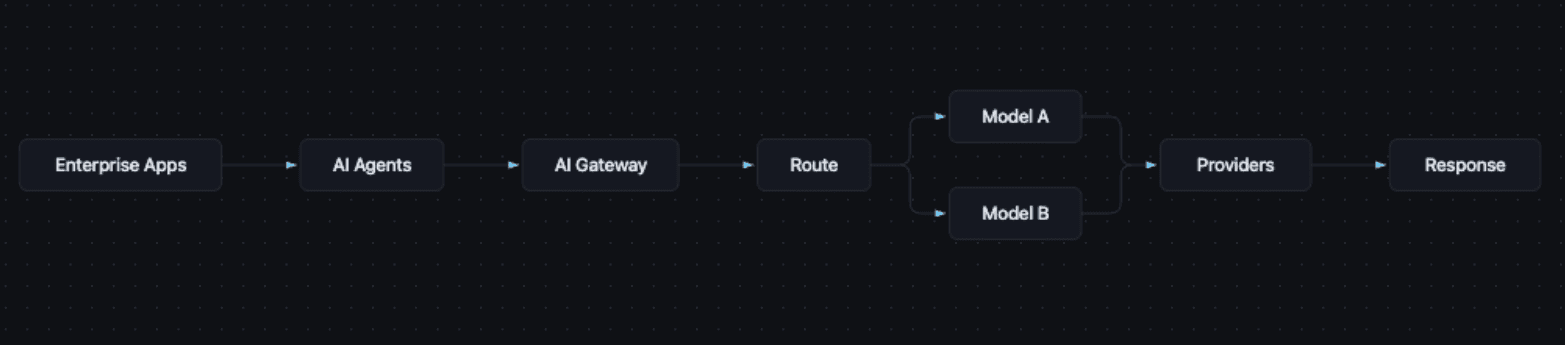
The full routing architecture requests pass through the gateway, get weighed on cost, quality, latency, capability, availability, reliability, and policy, and are sent to the right model and provider.
Once routing lives at this layer, applications stop needing to know the entire model ecosystem they just request a capability, and the layer underneath decides how to satisfy it. A new model ships? Evaluate it once, route to it everywhere. A provider raises prices? Change the policy, not the codebase. A model underperforms on one workload? Move that workload. A provider goes down or gets cut off overnight? Route around it automatically. The application doesn't get rebuilt every time the market shifts and lately, the market has been shifting fast.
The goal was never the cheapest model
Enterprise AI shouldn't turn into a race to the lowest token price. A cheap model that fails isn't cheap. A fast model with unreliable output isn't efficient. And an expensive model is easily justified when the cost of a wrong answer dwarfs the cost of inference.
The real objective is the lowest cost for the required outcome balancing cost, quality, latency, and reliability against actual business impact. Not just token price. Not just a leaderboard.
Where this leaves most teams today
For a long time, enterprise AI strategy was: "We use Model X." That made sense when the model landscape was small and applications were simple. It doesn't hold anymore not with dozens of viable models across a dozen-plus providers, price gaps of 10x or more between them, and availability that can change overnight for reasons that have nothing to do with your application.
This is exactly the gap we've been building toward at Hrida AI: an internal AI gateway that sits between your applications and your model providers, so a workflow can request a capability not a specific model and let the gateway handle routing, fallback, and cost tradeoffs behind a single API. Build the application once. Route intelligently by cost, quality, and reliability. Swap providers without rewriting anything upstream. We're not ready to open the doors on it just yet but it's closer than you'd think. Days, not months.
The question is changing
For years, enterprise AI asked: which LLM is the best? That made sense when the job was picking one model and integrating it.
The better question now is: which model is best for this task? And close behind it: can the infrastructure make that decision for us, automatically, every time?
That's where intelligent model routing stops being a cost-optimization trick and becomes part of the architecture of enterprise AI itself. The future isn't one model that does everything it's a system that knows when to reach for something smaller, when to reach for something stronger, when to switch providers, and when the extra intelligence is actually worth paying for.
If everything in this post sounds like the exact problem sitting on your plate right now good. That's not an accident. Keep an eye on this space; you won't have to wait long to see what we've been building.
Your AI agent doesn't need one LLM. It needs the right model for the job.