Anyone Can Ship Software Now. But No One Can Explain How It Works.
A few years ago, building a functional application required a team of developers, weeks of implementation, and a considerable amount of technical expertise.
Today, you can describe an idea in plain English:
“Build me a SaaS platform with authentication, user dashboards, payments, notifications, and an admin panel.”
and within hours, sometimes minutes, an AI coding tool generates something that actually works: pages render, buttons function, the database connects, users can sign up, dashboards load, and it all feels almost magical.
This is the era of Vibe Coding.
And honestly?
Vibe coding is one of the most exciting things happening in software development today.
It has lowered the barrier to building technology. It allows founders to validate ideas faster. It helps developers move at incredible speed. It enables non-engineers to turn ideas into working products.
But there is an uncomfortable question that the industry needs to ask:
Are we building software faster than we are capable of understanding, securing, and maintaining it?
Because writing code is only a small part of building a real software product. And that distinction is where the real technical debt begins.
What Exactly Is Vibe Coding?
Vibe coding is broadly the practice of building software primarily by describing what you want to an AI system and allowing the model to generate most of the implementation.
Instead of manually writing every function, component, API, database query, and integration, the developer or sometimes a non-developer guides an AI through natural language.
The workflow often looks something like this:
“Create a login system.”
Then:
“Add Google authentication.”
Then:
“Create a dashboard.”
Then:
“Add subscriptions.”
Then:
“Fix this error.”
Then:
“Make it look better.”
Eventually, an entire application emerges, The developer may not fully understand every file. They may not understand every dependency. They may not know why a particular architectural decision was made But the application works And that is exactly what makes vibe coding both powerful and dangerous.
The software industry has traditionally assumed that the person shipping code understands the system they are shipping. Vibe coding challenges that assumption, The barrier to creating software is disappearing.
Unfortunately, the barrier to creating insecure and unmaintainable software is disappearing along with it. Security organizations are increasingly highlighting this governance gap, and OWASP's current guidance explicitly warns against inappropriate trust in AI-generated code.
The Biggest Advantage of Vibe Coding: Speed
Let's be clear. Vibe coding is not the enemy. It solves a real problem. Traditional software development can be slow.
A simple idea may require:
- Product discussions
- Technical specifications
- UI design
- Architecture planning
- Backend development
- Frontend development
- Database design
- Testing
- Infrastructure setup
- Deployment
For an early-stage founder trying to validate an idea, this can be expensive and time-consuming. Vibe coding changes that dramatically.
1. Faster Prototyping
A founder can test an idea before investing months of engineering effort. Instead of asking, "Should we spend six months building this?" they can ask, "Can we build something usable this week and see if people actually want it?" That is an enormous advantage.
2. Faster MVP Development
For startups, speed matters. Many startups fail not because they cannot build the product, but because they spend too much time building the wrong product. AI-assisted development allows teams to validate ideas faster, build demos quickly, test user behaviour, iterate based on feedback, and reduce initial development costs. For an MVP, this can be transformational.
3. Democratization of Software
Historically, having an idea was not enough you needed someone technical to build it. Today, designers, product managers, founders, researchers, and business professionals can create working prototypes themselves. This is a huge cultural shift. The question is no longer "Can you code?" It's increasingly becoming "Can you clearly describe the problem you're trying to solve?" That is powerful.
4. Developers Become Faster
Vibe coding isn't only for non-engineers. Experienced developers can use AI to generate boilerplate, create repetitive components, write tests, debug issues, explore unfamiliar frameworks, generate documentation, and accelerate refactoring. The best engineers aren't necessarily going to disappear in many cases, they'll simply become dramatically more productive.
But Here Is the Problem: Working Software Is Not the Same as Good Software
This is where the conversation becomes important. An AI can generate something that works but production software has to survive something far harder than a demo. It has to survive real users, bad users, and unexpected users; thousands of concurrent sessions; network failures, database failures, and third-party API outages; security attacks and malformed inputs; infrastructure hiccups, scaling pressure, and plain human error.
A prototype only needs to answer one question:
"Can this idea work?"
An enterprise system has to answer a much harder one:
"What happens when everything goes wrong?"
That is engineering. And it's exactly where experienced engineers start thinking differently
Engineers Don't Just Think About the Happy Path
An inexperienced developer or an AI following a simple prompt often focuses on the happy path.
For example:
User enters email → User enters password → Login successful.
Done.
But an experienced engineer immediately starts asking questions.
What if:
- The user enters an invalid email?
- The password is incorrect?
- The authentication provider is down?
- The database connection fails?
- The API times out?
- The user submits the form 100 times?
- Someone tries brute-force attacks?
- A malicious user manipulates the request?
- The same request is sent twice?
- The user's session expires?
- The token is stolen?
- The system receives 10,000 login attempts simultaneously?
A good engineer doesn't only think:
“How does this feature work?”
They think:
“How can this feature fail?”
And more importantly:
“What happens to the system when it fails?”
That difference is invisible during a demo. But it becomes painfully visible in production.
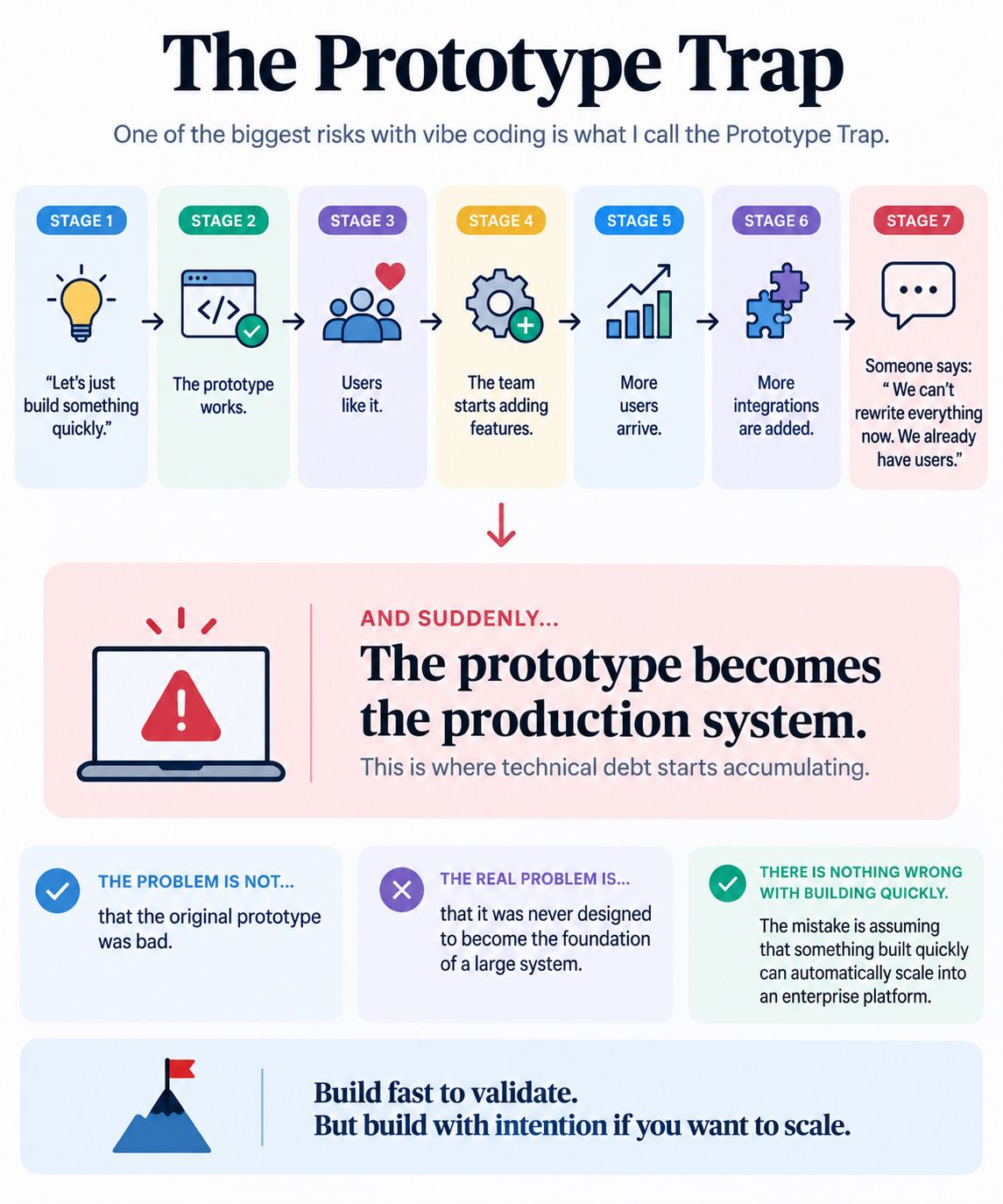
The Prototype Trap
One of the biggest risks with vibe coding is what I call the Prototype Trap,
and it tends to unfold in a familiar sequence: someone says, "Let's just build something quickly."
The prototype works. Users like it. The team starts adding features. More users arrive. More integrations get bolted on.
And eventually, someone says, "We can't rewrite everything now. we already have users." Suddenly, the prototype becomes the production system, and this is exactly where technical debt starts accumulating.
The problem was never that the original prototype was bad the problem is that it was never designed to become the foundation of a large system.
There's nothing wrong with building quickly; the mistake is assuming that something built quickly can automatically scale into an enterprise platform.
Technical Debt: The Hidden Cost of Fast Code
Technical debt is often misunderstood.
It does not simply mean: “Bad code.”
Technical debt means making a decision today that saves time now but creates additional work in the future.
Vibe coding can dramatically increase this risk.
Why?
Because AI makes implementation extremely cheap. When code becomes cheap, people generate more of it. When generating more code becomes easy, people create more features. And when features are created without architectural discipline, complexity grows faster than understanding.
You may suddenly have:
- Thousands of lines of code
- Dozens of dependencies
- Multiple APIs
- Background workers
- Authentication logic
- Payment integrations
- Database migrations
But nobody fully understands how everything connects. That is not just technical debt. That is technical uncertainty. And uncertainty becomes expensive.
AI Can Generate Code. It Does Not Automatically Understand Your Architecture.
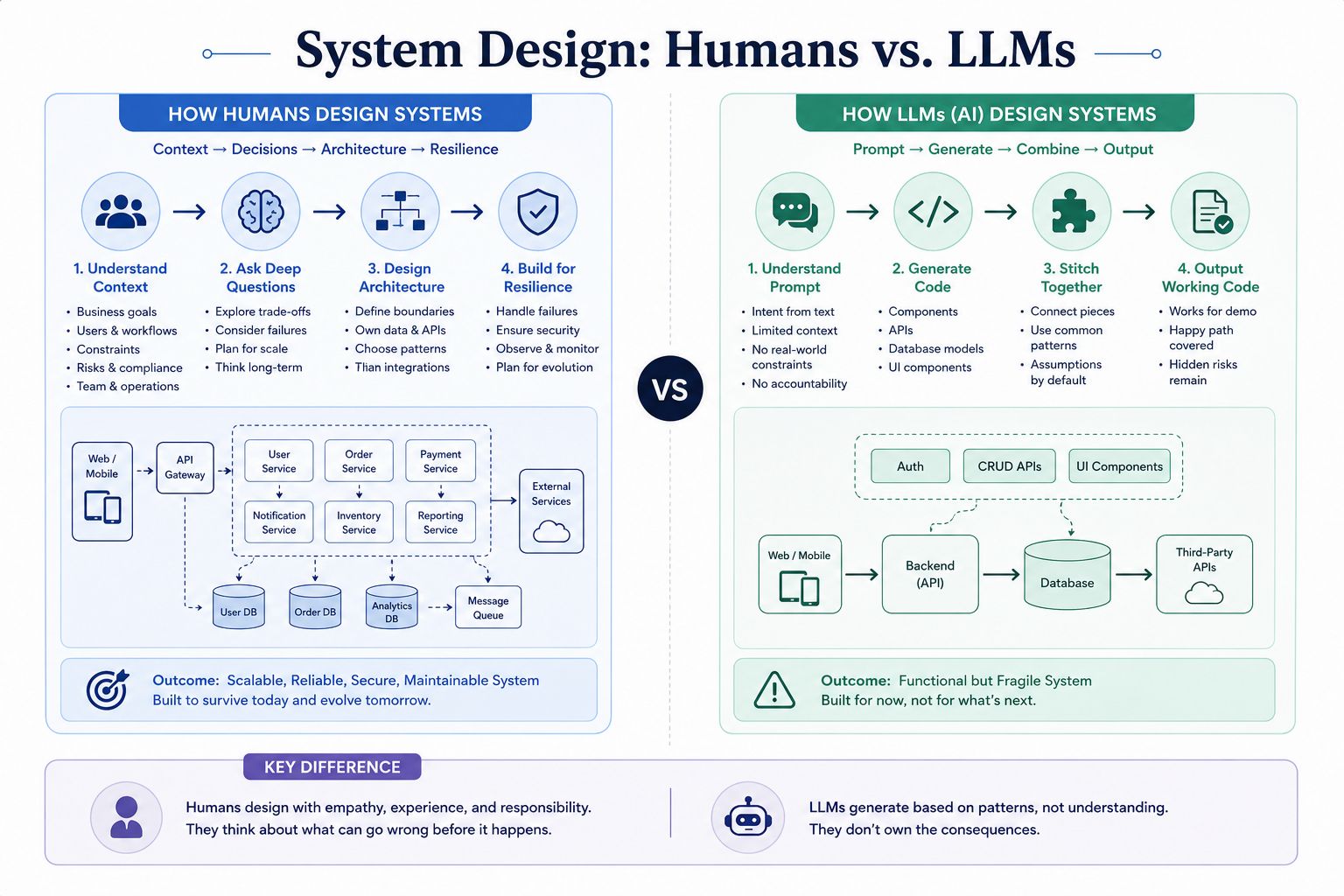
Generating Code Is Not the Same as Designing a System
An LLM can generate excellent code, but generating code is not the same as designing a system. Imagine asking an AI, "Build a customer management platform." The AI might generate authentication, APIs, database models, and UI components but architecture requires deeper questions than that.
Should this be a monolith or microservices? Where should the system boundaries sit, and what services own which data? How should authentication work across services, and what happens when a dependent service fails? Should communication be synchronous or asynchronous, and how do we handle retries without creating duplicate transactions? How do we scale individual components independently, and how do we migrate the system five years from now while maintaining backward compatibility?
These are not simply coding problems they are systems thinking problems. Architecture is the discipline of making decisions today that allow the system to survive tomorrow, and that requires context: business context, user context, technical context, operational context, security context.
An LLM can assist with those decisions. But blindly letting an LLM make them for you is a very different thing.
Security Is Where Vibe Coding Can Become Dangerous
Most AI coding tools optimize for one thing: satisfying the request in front of them. But nobody prompts, "Build me a secure authentication system with rate limiting, token rotation, session management, least-privilege authorization, and protection against common attack vectors." They just say, "Build me a login system." That gap matters OWASP's guidance on AI-assisted development explicitly warns that functionally correct code can still ship with insecure defaults, exposed endpoints, and weak access controls when security isn't explicitly designed for and independently verified.
1. Authentication Isn't Authorization
Authentication answers who are you. Authorization answers what are you allowed to do. A vibe-coded app might nail login and still let User A pull up User B's data simply by changing /api/customer/123 to /api/customer/124. That's not a coding bug; it's a missed authorization check, and it's exactly the kind of business-logic flaw that slips through when the goal is "make the feature work."
2. Hardcoded Secrets
AI-generated code can quietly embed API keys, database credentials, and tokens directly into files. It works fine until someone pushes it to a public repo. Best practice is to keep secrets out of AI context entirely and rely on proper secret management, not hardcoded values.
3. Insecure Dependencies
AI can suggest outdated, vulnerable, or even nonexistent packages. Your software's attack surface isn't just the code you wrote it's every dependency that code trusts, which makes supply-chain hygiene non-negotiable.
4. Security Misconfiguration
Sometimes the code is fine and the infrastructure isn't: public databases, open storage buckets, unprotected APIs, debug mode left on in production. The app works. The environment doesn't. OWASP flags misconfiguration as a major risk specifically in AI-assisted and citizen-development workflows which is why security can't be treated as just a code-review problem.
The Real Risk Is Blind Trust
The most dangerous sentence in software today might be: "The AI generated it, so it should be correct." It shouldn't be trusted any more than code copied from a random forum useful, but unverified until reviewed. OWASP calls this out directly: overreliance on AI output is itself a risk, especially when developers skip independent validation.
And when something breaks, the AI doesn't take the 2 AM incident call or explain a breach to customers. The team does. AI can generate code. It can't generate accountability.
Enterprise Software Is More Than Code
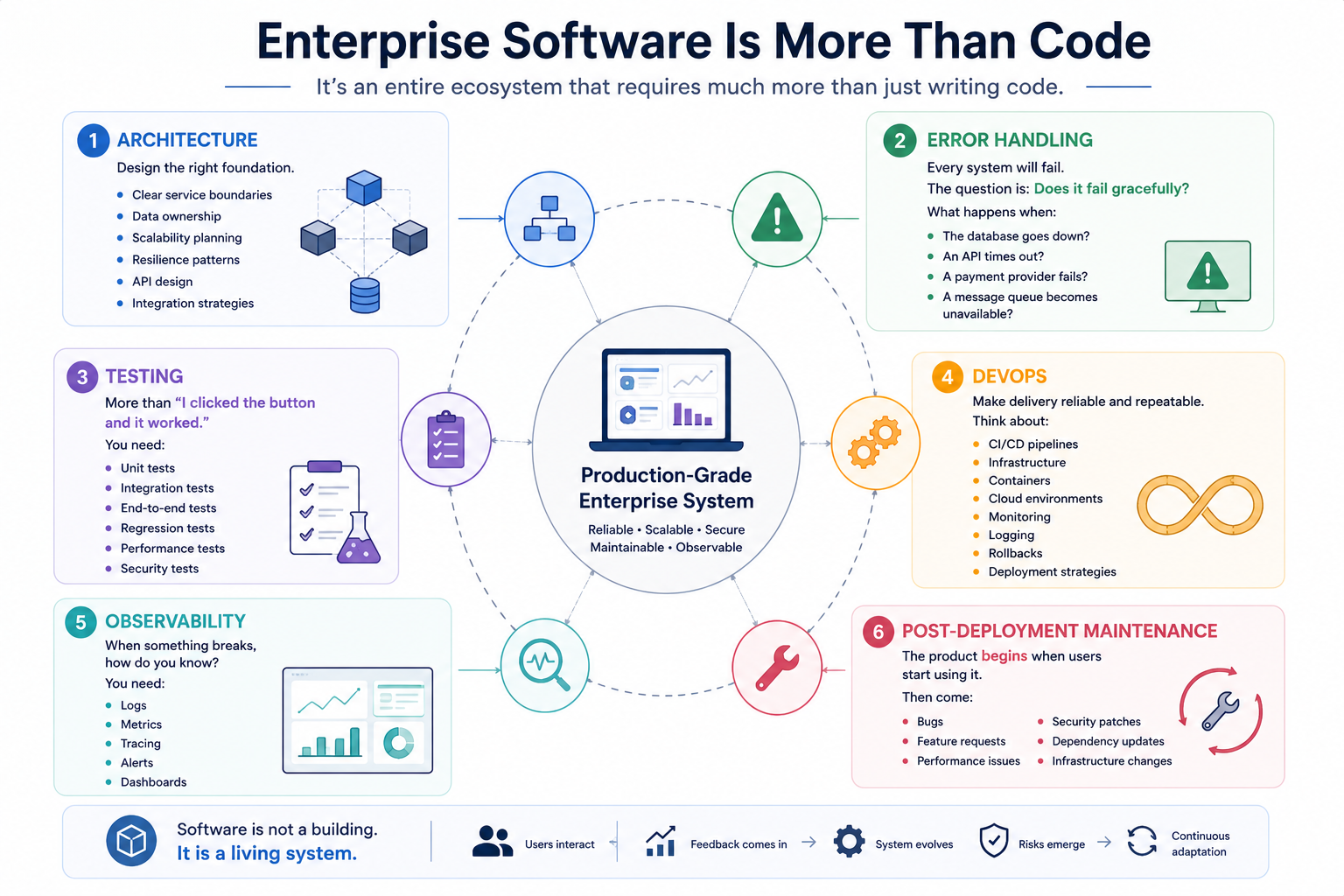
This is one of the biggest misconceptions in the current AI coding conversation people keep asking "how fast can AI write the application?" as if that's the whole job. Enterprise software isn't just an application; it's an entire ecosystem, and a production-grade system demands more than working code.
Architecture means clear service boundaries, defined data ownership, scalability planning, resilience patterns, and thoughtful API and integration design.
Error handling is about what happens when things break not if. What happens when the database goes down, an API times out, a payment provider fails, or a message queue becomes unavailable? Good systems anticipate failure instead of hoping to avoid it.
Testing means more than "I clicked the button and it worked." It means unit tests, integration tests, end-to-end tests, regression tests, performance tests, and security tests.
DevOps covers CI/CD pipelines, infrastructure, containers, cloud environments, monitoring, logging, rollback strategies, and deployment discipline.
Observability answers the question: when something breaks in production, how do you know? That takes logs, metrics, tracing, alerts, and dashboards a system that can't explain itself is nearly impossible to maintain.
Post-deployment maintenance is the part people forget the product needs. Launch isn't the finish line it's where the real work begins: bugs, feature requests, performance issues, security patches, dependency updates, infrastructure changes.
Software isn't a building. It's a living system.
The Cost of Fast Development Can Appear Later
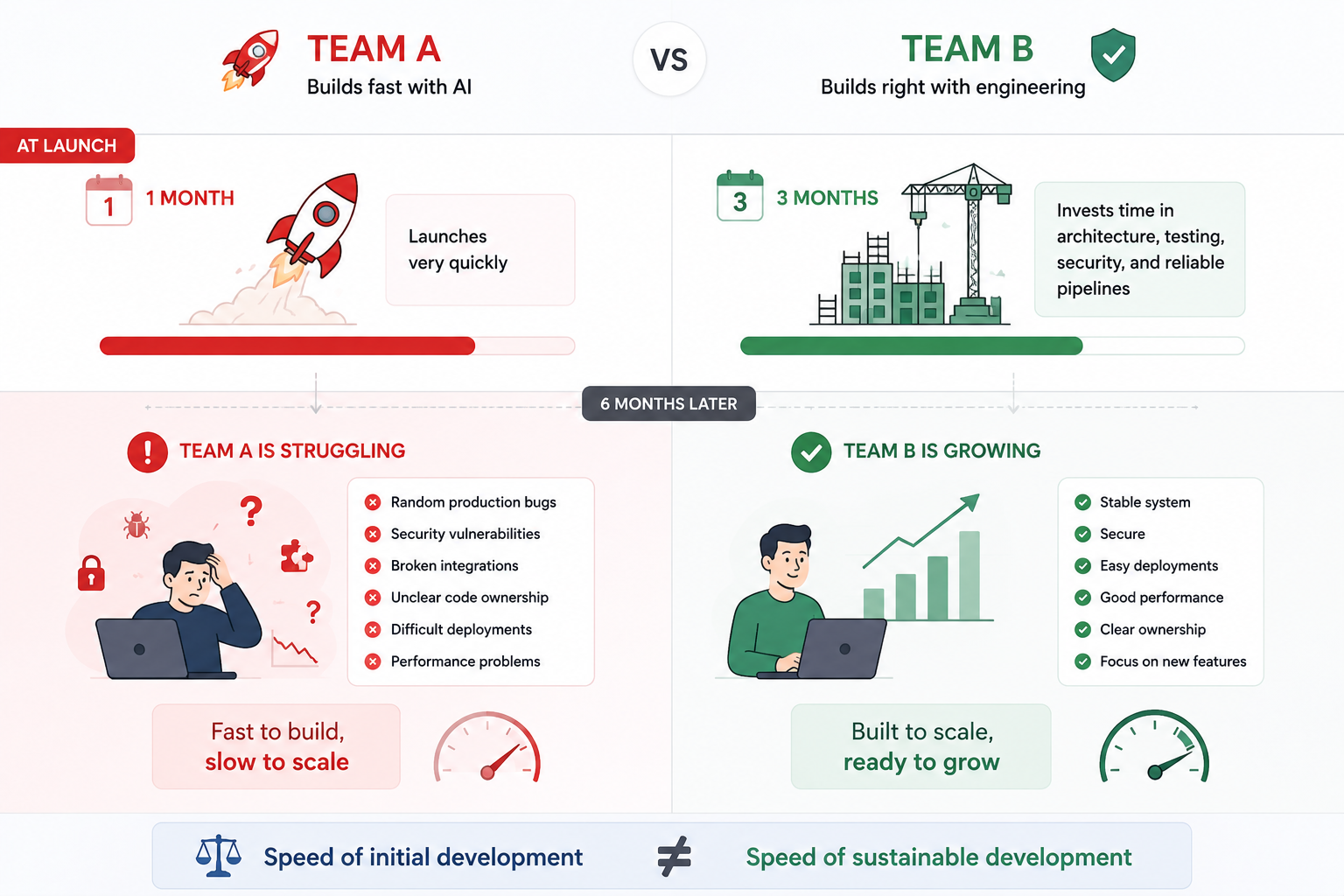
Imagine two teams. Team A builds everything fast with AI and launches in a month. Team B spends three months on architecture, testing, security, and reliable deployment pipelines. At first, Team A looks dramatically faster. Six months later, Team A is fighting random production bugs, security vulnerabilities, broken integrations, unclear code ownership, and painful deployments while Team B is still adding features confidently.
Speed of initial development and speed of sustainable development are not the same metric.
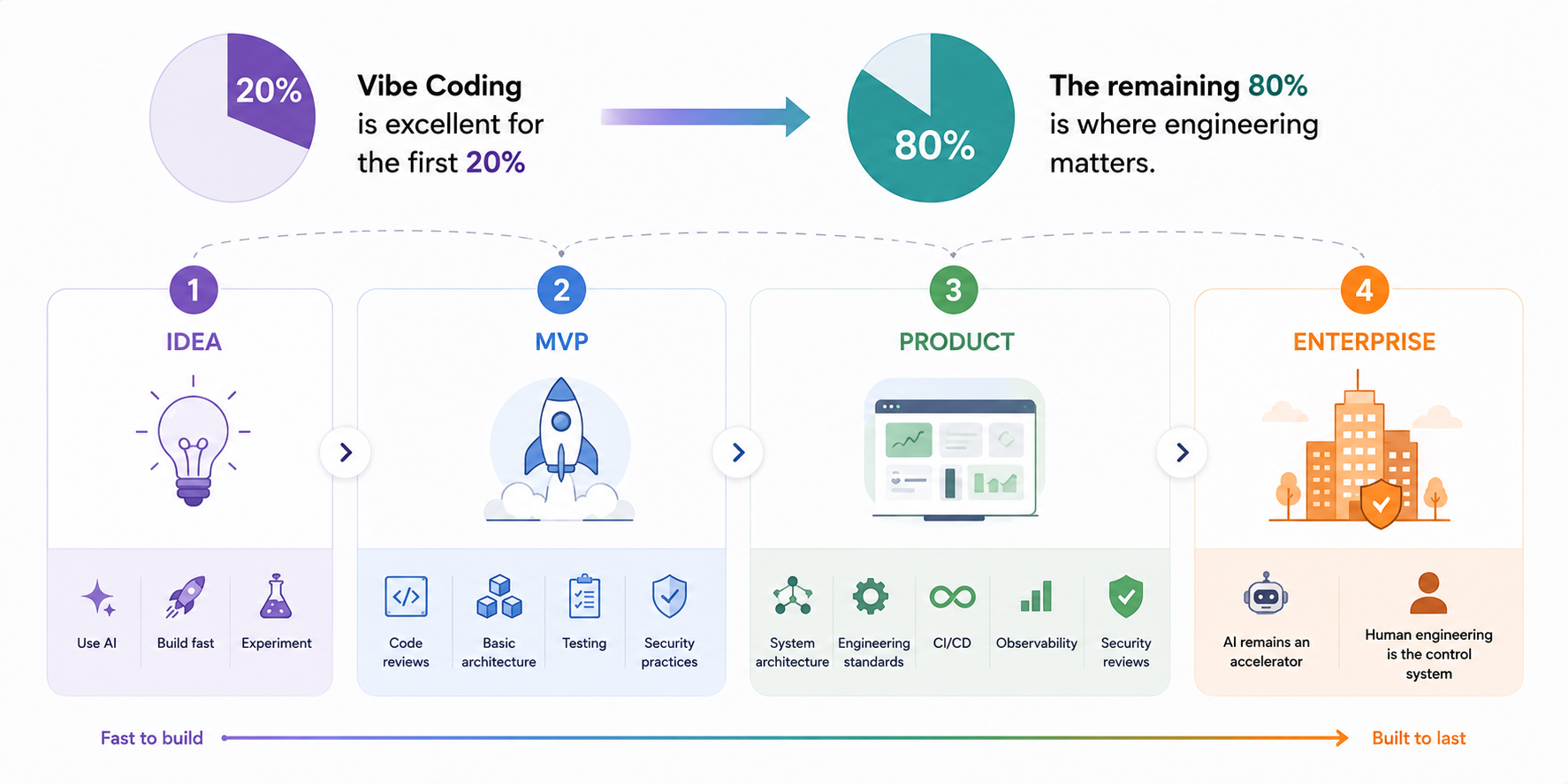
Vibe Coding Is Excellent for the First 20%
The remaining 80% is where engineering matters.
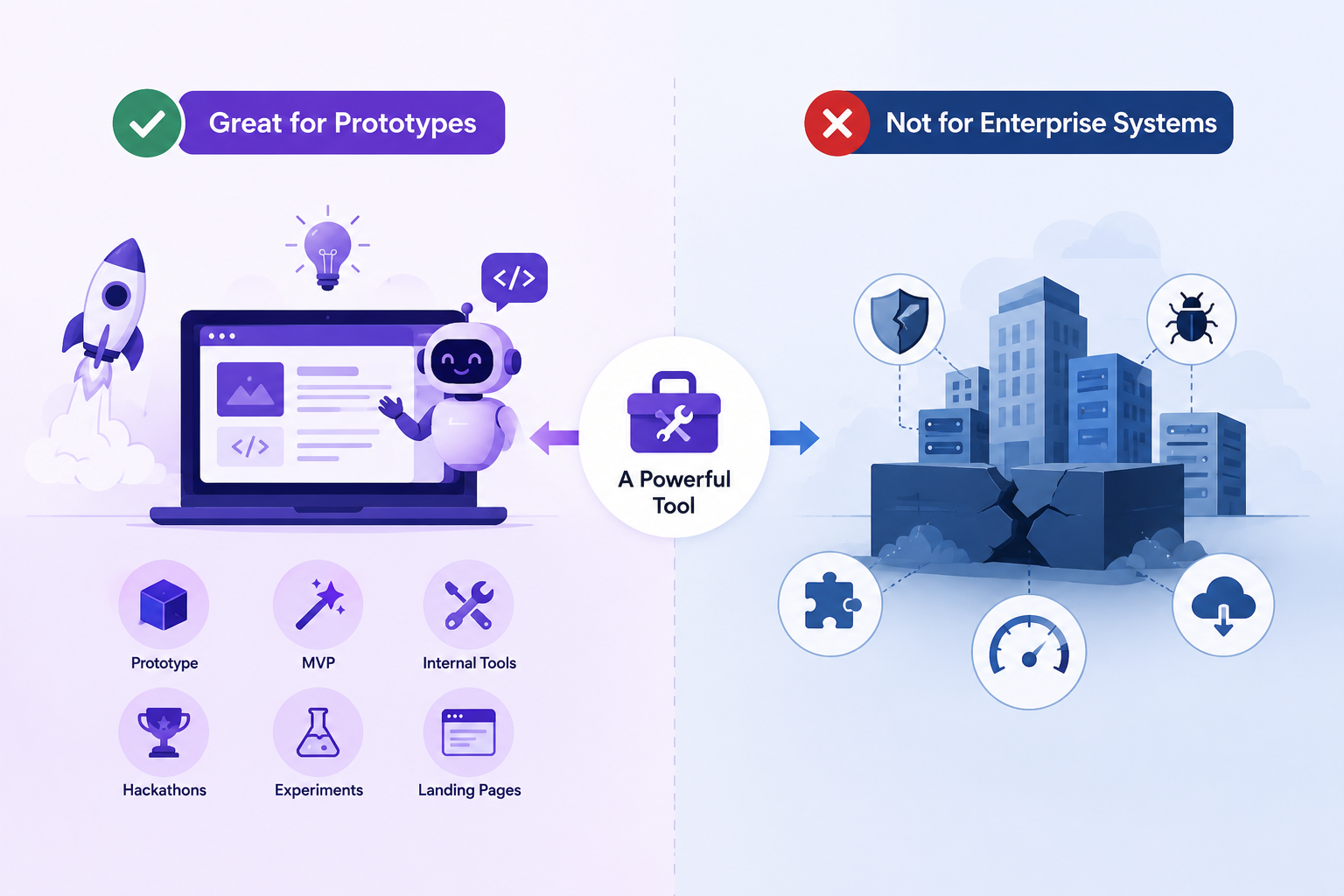
Vibe coding shines for prototypes, MVPs, internal tools, hackathons, experiments, and proofs of concept but as the system becomes critical, the engineering model has to evolve:
- Phase 1 (Idea): Use AI aggressively. Build fast, experiment freely.
- Phase 2 (MVP): Use AI to accelerate but start introducing code reviews, basic architecture, testing, and security practices.
- Phase 3 (Product): Bring in strong engineering ownership system architecture, standards, CI/CD, observability, security reviews.
- Phase 4 (Enterprise): AI stays an accelerator, but human engineering becomes the control system.
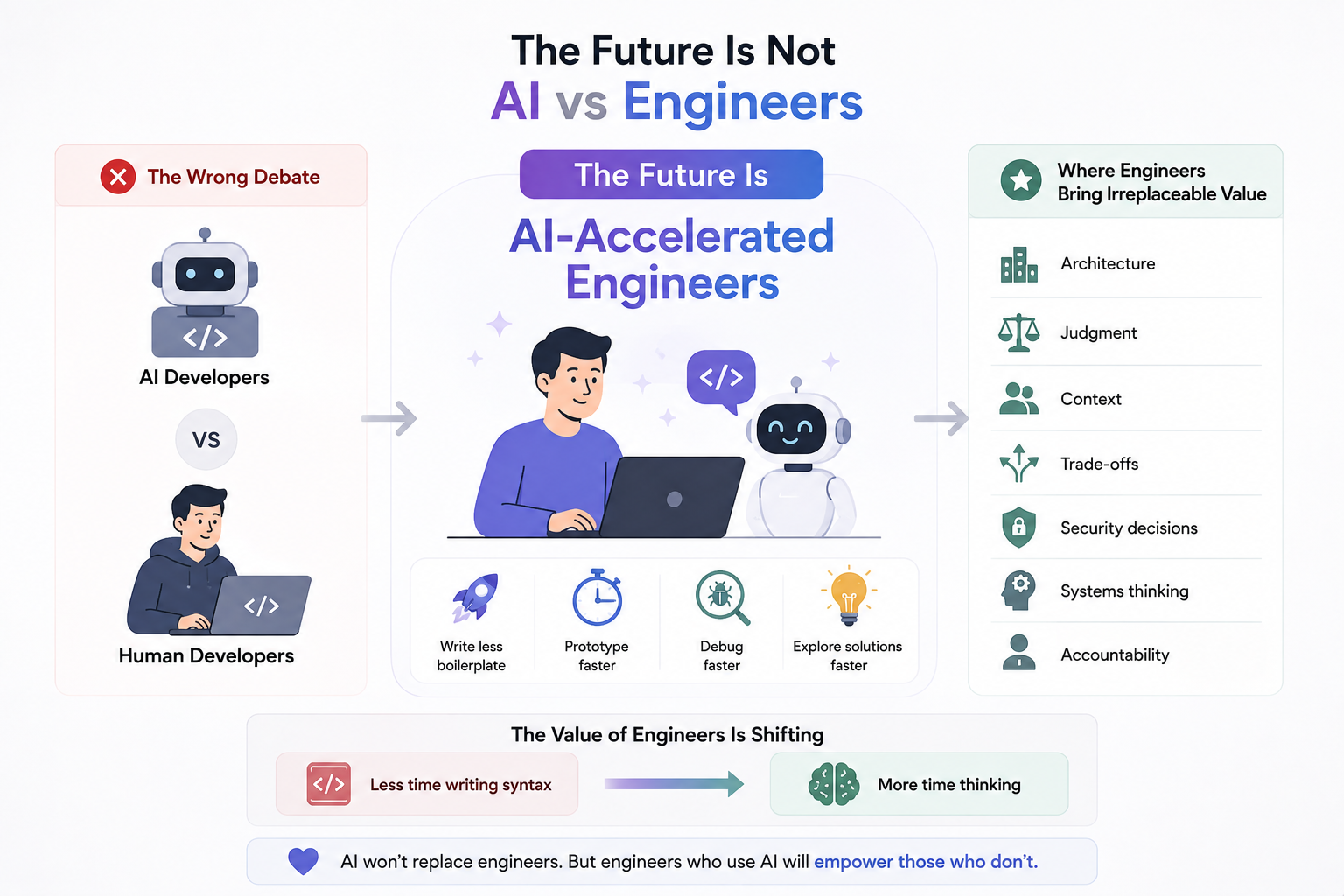
The Future Is Not AI vs. Engineers
That's the wrong debate.
It's not AI developers versus human developers it's AI-accelerated engineers.
The best engineers will write less boilerplate, prototype faster, and debug faster, but their real value will increasingly come from what AI can't safely own alone: architecture, judgment, context, trade-offs, security decisions, systems thinking, and accountability.
Less time writing syntax, more time thinking and that might be the best thing AI does for software engineering.
The New Role of the Engineer: From Code Writer to System Thinker
For decades, developers were partly measured by how much code they could write. That metric is losing meaning. If AI can generate 5,000 lines in minutes, the real question isn't "how fast can you write code?" it's "do you know what code should exist?" and, more importantly, "do you understand what happens when it fails?" The future engineer looks more like an architect, reviewer, systems thinker, security advocate, product thinker, and AI orchestrator. AI will write more code; humans will need to make better decisions.
So, Is Vibe Coding Good or Bad?
Neither Good Nor Bad : it's a tool, a powerful one.
The mistake isn't using vibe coding; it's using prototype-level thinking for enterprise-level systems.
You should absolutely use AI to build your product, but your engineering maturity needs to grow alongside your product's maturity. A startup prototype doesn't need banking grade architecture but once you're handling customer data, financial information, healthcare data, or critical business operations, you're no longer just building an application. You're building infrastructure people depend on, and that requires engineering.
The Real Technical Debt Behind Vibe Coding
The biggest technical debt vibe coding creates may not be bad code ,
it may be software that nobody truly understands.
Code can be refactored, infrastructure rebuilt, dependencies updated.
But a system with no ownership, no architectural understanding, no documentation, and no engineering discipline only gets harder to evolve.
AI makes creating software easier than ever. Maintaining it still requires responsibility and responsibility still requires people.
Vibe coding isn't going away, and it shouldn't but actually, it's democratizing technology, empowering founders, and making developers dramatically more productive. But speed isn't engineering maturity. A prototype that works isn't necessarily a product. A product isn't necessarily a scalable system. A scalable system isn't necessarily secure. AI can move us through that journey faster, but it can't eliminate the need for architecture, engineering judgment, security, testing, DevOps, observability, maintenance, and accountability.
The future isn't about choosing between AI and engineers, it's about knowing where AI accelerates us, and where human judgment matters more than ever. Because in the age of vibe coding: writing code is becoming cheaper, and thinking is becoming more valuable.
The companies that understand that difference will build not just faster software but software that survives.
One Principle Worth Remembering
Vibe code to discover what is possible. Engineer to ensure what is possible can survive reality.